
DeepSeek vs ChatGPT: Full Feature Comparison for 2026
The two most-discussed AI chatbots of 2026 are DeepSeek and ChatGPT, but they have different problems to solve. Make DeepSeek your go-to Reasoner for free, for coding, math and science, at a tiny fraction of the API cost. ChatGPT is the winner when it comes to the features, multimodal functionality and enterprise readiness. You need to go with what you actually need, that is just the right option.
Fast Comparison: DeepSeek vs ChatGPT at a Glance
| Category | DeepSeek | ChatGPT | Winner |
|---|---|---|---|
| Best Model | V3.2 / V3.2 Speciale | GPT-5.4 | ChatGPT |
| Free Reasoning | Unlimited DeepThink | 10 msgs / 5 hrs | DeepSeek |
| API Cost (1M tokens) | $0.28 / $0.42 | $2.50 / $15.00 | DeepSeek |
| Multimodal (video, audio) | No | Yes | ChatGPT |
| Open Source | Yes (MIT) | No | DeepSeek |
| Self-Hosting | Full support | Not available | DeepSeek |
| Privacy (cloud) | China-based servers | US-based, SOC 2 | ChatGPT |
| Enterprise Readiness | Limited | SOC 2, SSO, 60+ integrations | ChatGPT |
| Benchmark Score (Intelligence Index) | 42 (V3.2) | 57 (GPT-5.4 xhigh) | ChatGPT |
Performance: Where Each Model Actually Excels
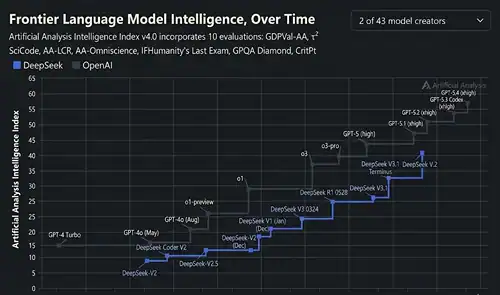
On the Artificial Analysis leaderboard, GPT-5.4 holds an Intelligence Index score of 57 versus DeepSeek V3.2’s 42. The LM Arena scores tell the same story: ChatGPT 5.4 sits at 6th place with an ELO of 1485, while DeepSeek V3.2 ranks 45th at 1424.
That gap looks decisive. But context matters. DeepSeek’s V3.2 Speciale model scored 96.0 on AIME 2025 versus GPT-5 High’s 94.6. On Humanity’s Last Exam, DeepSeek scored 30.6 to ChatGPT’s 26.3. These aren’t cherry-picked results; they reflect a model genuinely competitive on hard reasoning tasks, particularly in math and scientific problem solving.
Where ChatGPT pulls clearly ahead is speed. GPT-5.4 generates 74 tokens per second. DeepSeek V3.2 manages 43. For users doing extended research sessions or quick Q&A, that difference is noticeable.
One area where DeepSeek wins on principle: chain-of-thought transparency. You can actually read DeepSeek’s internal reasoning steps before the final answer. ChatGPT shows a sanitized summary. If you’re debugging a model’s logic or building educational tools, that raw CoT access matters in ways the benchmark numbers don’t capture. If you’re the kind of person who likes digging into how AI tools actually work, you’d appreciate the same transparency discussed in this Zawa AI review for a different class of AI product.
Coding Performance: The Honest Breakdown
SWE-Bench Verified is the most respected real-world coding benchmark available. DeepSeek V3.2 scores 73.1%. OpenAI’s GPT-5.3 Codex, built specifically for programming, hits 80%. Now, that is a considerable margin for someone working as a professional software engineer shipping production code. There’s an important nuance here. There has been no DeepSeek Copilot-style model from DeepSeek since the 2024-specific one: DeepSeek Coder. The numbers will follow and when that changes, they will change as well. Right now, the typical failure point for DeepSeek on complex engineering tasks is documentation quality and test coverage, not raw code generation.
For individual developers on the free tier, DeepSeek competes respectably. The real separation happens in ecosystem: ChatGPT’s Codex platform integrates directly with GitHub, supports VS Code plugins officially, and handles PRs, commit messages, and README generation in ways DeepSeek’s current tooling doesn’t match.
Pricing: The Gap Is Enormous
This is where DeepSeek’s case becomes almost unarguable. The chatbot is completely free, with no subscription tier. DeepThink reasoning mode has no hard cap. Compare that to ChatGPT’s free tier, which limits GPT-5.3 access to 10 messages every 5 hours and puts reasoning model usage behind similar restrictions.
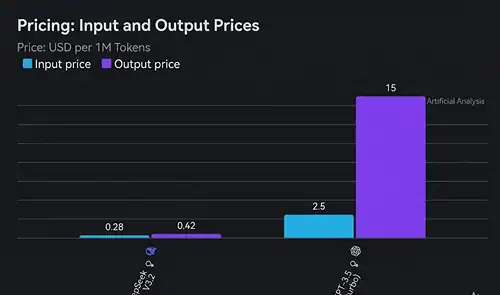
On the API side, the numbers are stark. DeepSeek charges $0.28 per million input tokens and $0.42 per million output tokens. GPT-5.4 costs $2.50 input and $15.00 output. That’s about 9 times more expensive on input and 35 times on output. For startups, researchers or even any cost-sensitive AI workloads, that difference is not marginal, it determines whether you have a product viable enough to avoid ending in a scrapheap of failed projects.
| Plan | DeepSeek | ChatGPT |
|---|---|---|
| Paid Subscription | Completely free | $8 (Go), $20 (Plus), $200 (Pro) |
| Free Web Access | Yes | Yes (limited) |
| API Input (1M tokens) | $0.28 | $2.50 |
| API Output (1M tokens) | $0.42 | $15.00 |
| Self-hosting | Yes | No |
Privacy and Security: A Real Concern for US Users
DeepSeek processes and stores user data on servers located in China. Under Chinese law, companies have no legal mechanism to refuse government data requests; there’s no court challenge equivalent to what US-based companies can exercise. Several governments globally have restricted or banned DeepSeek on these grounds, particularly for official and enterprise use.
This does not make DeepSeek unusable, but it sets a limit. Personal use, research, and experimentation on non-sensitive data for open-source work is usually acceptable. Business data, patient information, legal documents, and government records should not go through DeepSeek’s cloud service.
The self-hosting option largely resolves this. Running DeepSeek on your own infrastructure eliminates the data residency concern entirely, which is why the open-source licensing matters practically, not just philosophically.
ChatGPT operates on US-based servers with SOC 2 Type II compliance. Enterprise and Business plans guarantee that user data isn’t used for model training. OpenAI also maintains active compliance engagement with government frameworks, which matters for organizations with regulatory obligations.
Pro Tips: What Most Comparisons Miss
On DeepSeek’s free reasoning
The lack of a hard cap on DeepThink mode is more significant than it sounds. When testing complex multi-step math or science problems, DeepSeek’s free tier genuinely outperforms the free tier of every major ChatGPT competitor. The ceiling for free users is much higher.
On API cost calculations
If you’re building an application that sends 500,000 output tokens per day, the annual cost difference between GPT-5.4 and DeepSeek V3.2 exceeds $1.2 million. That’s not a rounding error. Run your own usage math before committing to a provider.
On self-hosting complexity
Self-hosting DeepSeek isn’t a casual weekend project. The full V3.2 model requires substantial GPU infrastructure. Quantized versions run on consumer hardware but sacrifice some accuracy. Factor this into your cost model before deciding that self-hosting is the privacy-compliant path.
On enterprise decisions
For US enterprise buyers, ChatGPT’s compliance documentation is substantially more mature. SOC 2, HIPAA-eligible configurations, and SSO are table stakes for regulated industries. DeepSeek’s enterprise story doesn’t yet exist at that level, regardless of the cost savings.
Who Should Use Which: A Decision Framework
| User Type | Pick | Why |
|---|---|---|
| Students & Researchers | DeepSeek | Free reasoning with no hard cap beats ChatGPT’s restricted free tier on long, complex sessions. Math and science performance is strong. |
| Professional Developers | ChatGPT | Codex’s GitHub integration and VS Code support create a workflow advantage. SWE-Bench scores reflect real production tasks. |
| Cost-Sensitive API Users | DeepSeek | At 9–35x lower API cost with competitive performance, DeepSeek is the rational choice for high-volume inference workloads. |
| Enterprise / Regulated Industries | ChatGPT | SOC 2 compliance, SSO, US-based data residency, and 60+ business integrations make ChatGPT the only viable enterprise option. |
| Content Creators & General Use | ChatGPT | Memory, voice mode, image and video generation, and Sora 2 integration make ChatGPT a genuinely more complete creative tool. |
| Privacy-Conscious Developers | DeepSeek (self-hosted) | MIT license, full self-hosting support, and no cloud dependency make DeepSeek the only real option for sensitive local deployments. |
FAQ
Is DeepSeek better than ChatGPT for coding?
For most professional coding tasks, ChatGPT is currently stronger. GPT-5.3 Codex scores 80% on SWE-Bench Verified versus DeepSeek V3.2’s 73.1%. The gap is larger when you factor in ChatGPT’s GitHub integration and official IDE plugins. For free users doing algorithmic work or debugging, DeepSeek’s no-cap reasoning makes it competitive.
Is DeepSeek safe to use in the US?
For personal use and non-sensitive topics, risk is low. For business data, healthcare information, or anything regulated, the China-based server location is a genuine compliance issue. Self-hosting the open-source model eliminates data residency concerns entirely, but requires significant infrastructure investment.
Can DeepSeek replace ChatGPT for free?
It depends on your use case. If you need reasoning performance, math, coding, or scientific analysis without paying, DeepSeek’s free tier outperforms ChatGPT’s free tier substantially. If you need multimodal features, image generation, or voice mode, DeepSeek can’t replace ChatGPT regardless of cost.
What is the difference between DeepSeek R1 and ChatGPT o1?
Both are reasoning models that use chain-of-thought inference. The key difference is transparency: DeepSeek R1 shows its full reasoning trace, while ChatGPT o1 shows a sanitized summary. On raw benchmark performance at launch, the models were closely matched. DeepSeek R1 is free and open-source; o1 is behind ChatGPT Plus.
How much does DeepSeek cost compared to ChatGPT?
DeepSeek’s chatbot is completely free with no subscription. ChatGPT’s paid plans start at $8 per month. On the API side, DeepSeek costs $0.28/$0.42 per million input/output tokens versus ChatGPT’s $2.50/$15.00, making DeepSeek approximately 9x cheaper on input and 35x cheaper on output.
Which AI chatbot is best for students in 2026?
DeepSeek is the practical recommendation for students, especially in STEM fields. The free reasoning model handles complex math, physics, and programming problems without the session limits that restrict ChatGPT’s free tier. The trade-off is a less polished interface and no multimodal features.
Does DeepSeek work without a subscription?
Yes. DeepSeek has no paid subscription tier at all. The full chatbot, including DeepThink reasoning mode, is available for free. There are no daily message caps publicly enforced on the reasoning model, which makes it the most accessible frontier reasoning tool currently available.
Your Next Steps
If you’re starting today: try DeepSeek’s free chatbot at deepseek.com for your next math, coding, or research task and compare the quality directly against ChatGPT’s free tier. The performance difference is more apparent in complex multi-step problems than simple queries.
For developers evaluating the API: run a small 1,000-token test with identical prompts through both the DeepSeek API and OpenAI’s API, then multiply your realistic monthly volume by the pricing difference. The math often changes decisions quickly.
For enterprise evaluation: review OpenAI’s SOC 2 Type II report and their enterprise data processing agreement before comparing features. Compliance documentation is the gate for regulated industries, and only one provider currently passes it cleanly.
Related reading worth exploring: a comparison of DeepSeek versus Gemini for API cost efficiency, a breakdown of how to self-host DeepSeek on a home server, and an analysis of ChatGPT’s Codex platform for production engineering teams. If you’re also evaluating AI tools for gaming or entertainment use cases, the game codes resource covers a different but adjacent space worth bookmarking.
Share this article

Ryan has been playing Roblox since 2017. He started keeping a personal spreadsheet of codes that actually worked after getting burned one too many times by lists that hadn't been updated in weeks. That spreadsheet turned into BossGamerz. He still plays Blox Fruits and King Legacy regularly — not to write about them, but because he genuinely enjoys them. He handles what gets published and what doesn't. If a code list goes up on this site, he's either tested it himself or someone on the team has done it in front of him.
View all articles
No comments yet
Be the first to start the conversation!